1. Technical Demystification: What Defines a High-Reliability Constant Current LED Driver?
In modern solid-state lighting (SSL) engineering, the Constant Current LED Driver serves as the fundamental power regulation unit responsible for maintaining optical consistency, thermal stability, and operational longevity of Light Emitting Diodes. Unlike conventional silicon load circuits that accept constant voltage regulation, LEDs are PN-junction semiconductor devices possessing a non-linear exponential Current-Voltage ($I-V$) curve. A minor fluctuation in forward voltage ($V_f$) across an LED array can trigger a massive exponential jump in forward current ($I_f$), causing extreme thermal dissipation, lumen degradation, and eventual catastrophic diode breakdown due to a phenomenon known as thermal runaway.
A premium Constant Current (CC) LED driver eliminates this risk by continuously monitoring the secondary loop amperage and dynamically altering its output voltage within a designated compliance range ($V_{out\_min}$ to $V_{out\_max}$). Whether the junction temperature fluctuates, or individual LED chips experience forward voltage variance due to manufacturing batch tolerances, the CC driver dynamically balances the electrical circuit to ensure a stable electrical load.
Key Information Gain for Power Engineers:
The forward voltage of an LED chip exhibits a negative temperature coefficient (typically $-2\text{ mV/}^\circ\text{C}$ to $-4\text{ mV/}^\circ\text{C}$ per die). As operating temperatures rise inside an industrial luminaire enclosure, the LED array's aggregate $V_f$ decreases. A Constant Current driver dynamically lowers its voltage output while locking output current down to $\pm 2\%$ accuracy, preventing elevated junction temperatures ($T_j$) from exceeding safe rated thresholds ($T_{j\_max} \le 125^\circ\text{C}$).
Comparative Architecture: Constant Current (CC) vs. Constant Voltage (CV) Drivers
Global buyers frequently encounter confusion when selecting between Constant Current and Constant Voltage power units. The table below highlights the critical electrical, mechanical, and architectural parameters that govern this selection process for enterprise-scale lighting installations:
| Electrical Parameter |
Constant Current (CC) LED Driver |
Constant Voltage (CV) Power Supply |
| Primary Output Characteristics |
Fixed Amperage (e.g., 350mA, 700mA, 1050mA) / Dynamic Variable Voltage |
Fixed Voltage (e.g., 12VDC, 24VDC, 48VDC) / Dynamic Variable Current |
| Typical LED Connection Topology |
Direct connection to series-connected High-Power LED COBs or modules |
Parallel connected LED flexible strips with built-in current-limiting resistors |
| Power Efficiency ($\eta$) |
High efficiency (up to 95-96%) due to zero linear resistor power dissipation losses |
Moderate efficiency (82-88%) caused by inline resistor heat dissipation |
| Risk of Thermal Runaway |
Completely eliminated; drive current is strictly regulated regardless of temperature |
High if operated without active secondary linear current regulators |
| Lumen Uniformity across Run |
Identical luminous intensity across all diodes in series string |
Potential voltage drop across long wire runs causing dimming at remote ends |
| Primary B2B Target Applications |
Commercial Downlights, Municipal Street Lighting, High-Bay Warehouses, Architectural Projectors |
Cabinet Accent Lighting, Outdoor Neon Flex, LED Signage Backlighting Modules |
2. Recommended Industrial Constant Current LED Drivers & Power Modules
Engineered in our 19,500 m² state-of-the-art facility, AWI Power Co., Ltd. produces industrial-grade power solutions that strictly adhere to ISO 9001:2015 quality standards and international safety compliance. Below are our flagship series recommended for OEM integration, municipal projects, and harsh environment installations:
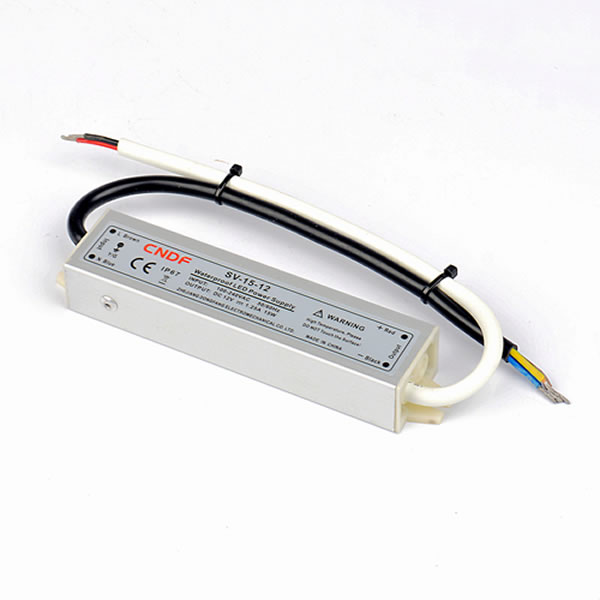
SV Series - Waterproof IP67/IP68 Driver
Designed for outdoor street lighting, tunnel luminaires, and architectural floodlights subject to extreme moisture and dust.
- Power Range: 15W - 300W
- Input Voltage: 90-305VAC Universal
- Protection Rating: IP67 / IP68 Fully Potted
- Efficiency: Up to 93.5%
- Surge Protection: 6kV / 10kV (IEC 61000-4-5)
View Technical Specs
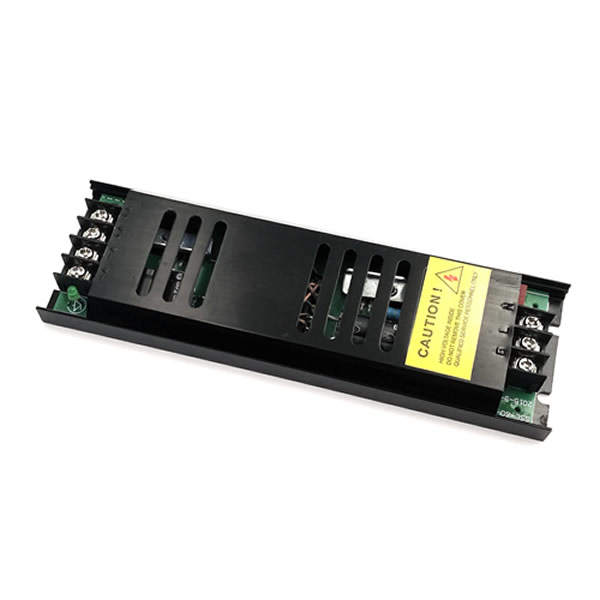
SSL Series - Super Slim Linear Driver
Ultra-narrow form factor optimized for space-constrained linear architectural slot lights and display fixture integration.
- Power Range: 30W - 100W
- Height Profile: Ultra-low 16mm / 21mm
- Power Factor: PF > 0.98 @ 230VAC
- THD: < 8% at Full Load
- Certifications: CE, RoHS, Class 2
View Technical Specs
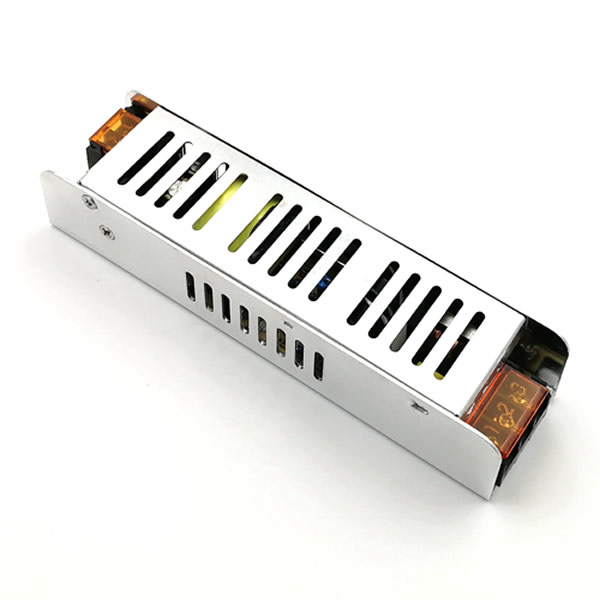
SL Series - Compact Industrial LED Driver
High reliability switching supply with reinforced aluminum housing for indoor commercial recessed panels and bay lights.
- Power Range: 15W - 150W
- Current Accuracy: ± 2.5%
- Operating Temp: -40°C to +70°C
- MTBF: > 500,000 Hours
- Safety Isolation: 3750VAC I/P-O/P
View Technical Specs
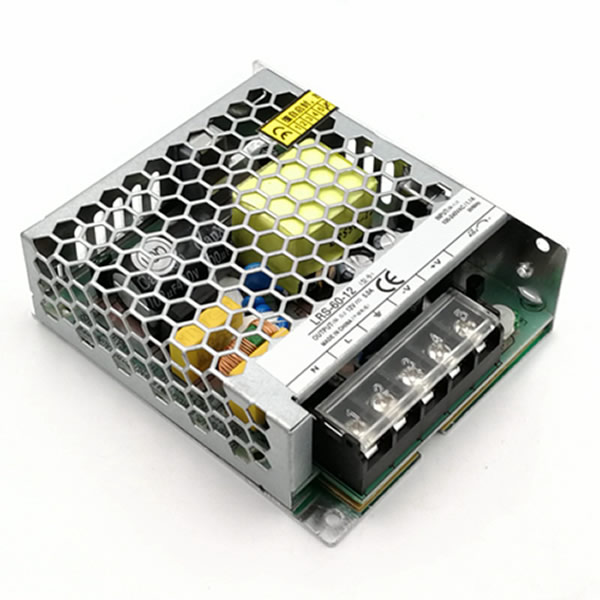
LRS Series - Ultra-Thin Enclosed Driver
Low-profile mesh casing providing efficient natural convection cooling for industrial automation and heavy-duty LED setups.
- Power Range: 35W - 350W
- No-Load Loss: < 0.3W Standby
- Vibration Resistance: 5G Peak Handling
- Protection: Short Circuit/Overload/OV
- Compliance: IEC/EN 62368-1, CE
View Technical Specs
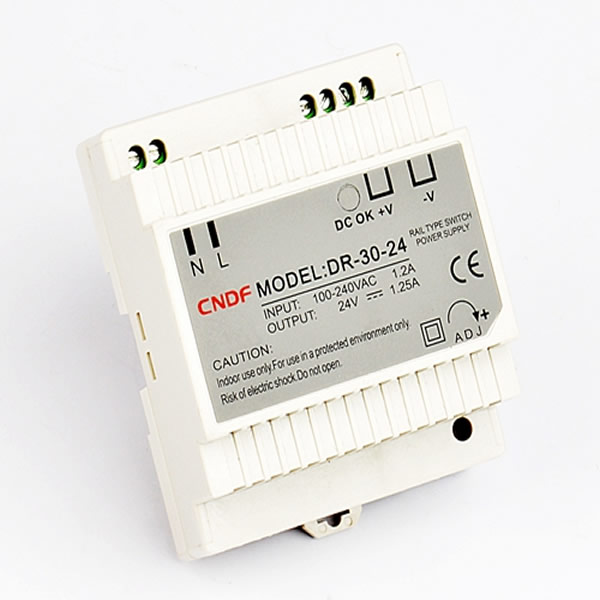
DR Series - Industrial DIN-Rail Driver
Designed for standard TS-35/7.5 or 15 DIN rail installation inside industrial control cabinets and smart city control boxes.
- Power Range: 15W - 120W
- Mounting Type: Standard DIN-Rail TS-35
- Insulation Class: Class II Isolation
- Cooling: Free Air Convection
- LED Indicator: DC OK Relay Output
View Technical Specs
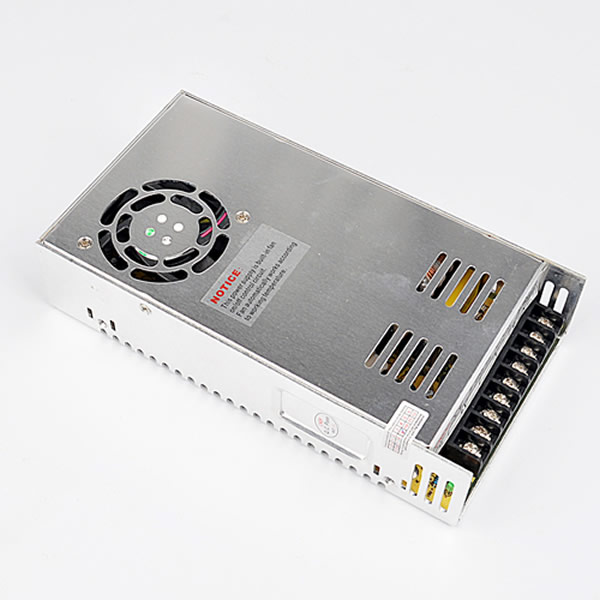
S Series - Heavy-Duty Modular Driver
High-capacity power unit designed for large-scale LED plant grow lights, stadium lights, and heavy machinery illumination.
- Power Range: 150W - 600W
- Active PFC: Built-in Active Power Factor
- Thermal Control: Smart Fan Speed Control
- Burn-In Test: 100% Full Load Tested
- Warranty: 3 to 5 Year B2B Warranty
View Technical Specs
3. Future Technology Trends & Sourcing Shift (2025–2030)
As the global lighting market shifts toward human-centric lighting (HCL), industrial IoT (IIoT), and aggressive decarbonization mandates, the technical architecture of Constant Current LED Drivers is undergoing rapid transformation. Procurement teams must account for four major technological developments when specifying power electronics for multi-year infrastructure cycles:
A. Wide Bandgap (WBG) Semiconductors: GaN and SiC Integration
Traditional silicon (Si) MOSFETs are reaching their theoretical physical limits in thermal efficiency and switching frequency. Next-generation Constant Current drivers developed by AWI Power Co., Ltd. incorporate Gallium Nitride (GaN) and Silicon Carbide (SiC) power switches. Operating at switching frequencies exceeding 500 kHz, GaN-based topologies drastically reduce magnetic component sizes (planar transformers and inductors), yielding power densities up to $25\text{ W/in}^3$ and peak conversion efficiencies exceeding 96.5%. This shift drastically lowers internal thermal stress, allowing for smaller, lighter luminaires.
B. Smart Multi-Protocol Dimming & D4i Connectivity
Simple analog dimming is rapidly giving way to digital control loops. Global buyers are increasingly standardizing on DALI-2 (IEC 62386) and D4i (DALI for IoT) standard compliance. Modern CC drivers act not only as power converters but as intelligent asset management nodes. They store driver operational data (luminaire telemetry, total energy consumption, temperature profiles, and diagnostic error codes) and communicate seamlessly with smart building management systems (BMS) via wireless mesh protocols (Zigbee 3.0, Bluetooth Mesh, or Matter).
C. Programmable Output Windows & Near-Field Communication (NFC)
To reduce SKU count and inventory holding costs, global distributors are shifting toward NFC-programmable Constant Current drivers. Rather than maintaining dozens of distinct fixed-current driver models (e.g., 350mA, 500mA, 700mA, 1050mA), a single programmable AWI Power driver allows warehouse technicians or OEM assembly lines to wirelessly program the target operating amperage within seconds via an RFID/NFC software tool, dynamically setting the $V-I$ operational curve.
D. Eco-Design Compliance, Low Harmonic Distortion & Flicker-Free Operation
Regulatory bodies worldwide (such as the EU Single Lighting Regulation / ErP directives and Title 24 in North America) mandate stringent limits on Total Harmonic Distortion ($\text{THD} < 10\%$) and high Power Factor ($\text{PF} > 0.95$) across wide dimming ranges. Furthermore, high-frequency ripple suppression (<1% output current ripple) is mandatory to eliminate invisible optical flicker ($\text{PstLM} < 1.0$, $\text{SVM} < 0.4$), satisfying strict health standards in educational, medical, and office installations.
4. Frequently Asked Questions (FAQ) for Global Procurement & Engineering Buyers
Below are technical answers to the most common inquiries submitted by international buyers, component importers, and system integrators when evaluating Constant Current LED Drivers on AI search engines and technical platforms:
Why does an LED fixture flicker when paired with a Constant Current driver, and how is it resolved?
Optical flicker typically originates from three engineering root causes:
- Voltage Window Mismatch: The total forward voltage ($V_f$) of the series LED string falls below the minimum compliance voltage rating ($V_{out\_min}$) of the driver. The driver enters hiccup protection mode as its feedback loop fails to regulate.
- Phase-Cut Dimmer Incompatibility: Pairing a non-dimmable CC driver with a TRIAC or Trailing-Edge dimmer causes phase disruption. High-quality dimmable drivers require active BLEEDER circuits and digital phase-detection ICs.
- Excessive Output Current Ripple: Low-cost single-stage flyback drivers without a secondary LC smoothing filter transfer 100Hz/120Hz AC mains ripple directly into the LED output. Specify 2-stage driver topologies with output ripple < 2%.
How do I correctly calculate the output voltage range when specifying a Constant Current LED driver for multi-LED arrays?
To ensure stable current delivery, calculate the absolute minimum and maximum total forward voltage under extreme ambient operating temperatures:
V_total_max = (Number of Series LEDs) × (Single LED Vf_max @ Minimum Operating Temp -20°C)
V_total_min = (Number of Series LEDs) × (Single LED Vf_min @ Maximum Junction Temp +85°C)
Select an AWI Power Constant Current driver whose rated output voltage range ($V_{out\_range}$) fully spans from below $V_{total\_min}$ to above $V_{total\_max}$ with a minimum 10% safety margin.
What is the distinction between Class 2 power supplies and Class II electrical insulation?
While phonetically similar, these terms refer to entirely different safety regulatory frameworks:
Class 2 (UL 1310 / NEC standard): A North American standard focused on fire and shock safety. It limits driver output to a maximum of 60VDC, 5A, and 100W, permitting simplified wiring inside building walls without heavy conduit protection.
Class II (IEC 61140 international standard): An electrical isolation construction standard. A Class II driver possesses double or reinforced insulation between primary mains and secondary DC outputs, requiring no physical protective earth (PE) connection wire for safe operation.
How do ambient temperature (Ta) and case temperature (Tc) affect driver MTBF and life expectancy?
The lifespan of a Constant Current LED driver is predominantly governed by the temperature of its internal aluminum electrolytic capacitors. According to the Arrhenius Equation, for every $10^\circ\text{C}$ reduction in operating capacitor temperature, lifetime doubles. AWI Power specifies maximum allowed case temperature ($T_c = 85^\circ\text{C}$) on product labels. Maintaining $T_c$ at or below $75^\circ\text{C}$ via proper luminaire heatsinking ensures operational longevity exceeding 50,000 to 100,000 hours.
What level of surge protection is required for outdoor municipal LED drivers?
Outdoor municipal applications (streetlights, sports stadium floodlights, architectural facades) are exposed to indirect lightning strikes and switching transients on the grid. Drivers must meet IEC 61000-4-5 surge immunity. Standard commercial drivers offer 2kV to 4kV protection, whereas AWI Power heavy-duty outdoor drivers feature integrated 6kV/10kV differential and common-mode surge protection, expandable to 20kV using external Surge Protection Devices (SPD).
5. Why Global Procurement Teams Partner with AWI Power Co., Ltd.
Established in 1989, AWI Power Co., Ltd. has grown over three decades into an internationally recognized manufacturer of AC-DC switching power supplies, waterproof LED drivers, power inverters, and cooling fans. Located in Yueqing Central Industrial Park, Wenzhou, Zhejiang Province, China, our modern 19,500 m² factory serves as a premier manufacturing hub for 15,600+ clients across 30+ countries.
| Manufacturing & Engineering Pillar |
AWI Power Enterprise Capability |
Direct Benefit to Global B2B Buyers |
| Vertical Production Integration |
In-house SMT surface mounting, transformer winding, aluminum casing extrusion, and automated potting lines. |
Total quality control, lower production costs, and guaranteed lead time execution. |
| Rigorous Quality Assurance |
100% full-load burn-in testing, automated optical inspection (AOI), surge generation, and thermal shock testing. |
Defect rates maintained below 150 PPM (Parts Per Million); zero field failures. |
| International Compliance |
Full certification portfolio: ISO 9001:2015, CE, RoHS, Class 2, EN 61347, CISPR 15 / EN 55015 EMC compliance. |
Hassle-free customs clearance and full legal compliance across North America, Europe, and Asia-Pacific. |
| OEM / ODM Customization |
Dedicated R&D engineering team capable of customizing output voltage windows, housing form factors, and cable harnesses within 2 weeks. |
Tailored power electronics matched to exact luminaire physical enclosures and thermal specifications. |
Request Custom Quotation or Engineering Evaluation Samples
Need customized Constant Current LED Drivers, IP67 waterproof power modules, or technical support for your upcoming commercial lighting contract? Speak directly with our power application engineers today.
 English
 中文
中文
 العربية
 Français
 Pусский
 Español
 Português