

Expert articles, application notes, and industry guides from AWI Power Co., Ltd.
In-depth insights into AC-DC switching power supplies, pure sine wave inverters, and thermal management.
Choosing the best DC Axial Fan manufacturer in China requires more than comparing prices or browsing polished websites. A dependable supplier should demonstrate practical experience with airflow, noise control, thermal management, and long-term motor performance. Factory visits, sample evaluations, and direct technical discussions often reveal more than product brochures. Look for clear specifications, including voltage range, rated current, air volume, static pressure, bearing type, and operating temperature.
Testing matters. A professional manufacturer should explain how each fan is inspected before shipment. Ask for airflow measurements, noise test conditions, vibration checks, and product life expectations. Reliable factories may provide production records, quality-control procedures, and relevant certifications for target markets. Engineers should also understand application details, such as cabinet depth, restricted ventilation paths, dust exposure, and continuous operating hours. Small details affect real performance.
No supplier is perfect. Some published data may come from ideal laboratory conditions rather than your actual equipment. That difference deserves attention. Request samples and test them inside the intended enclosure, not only on a workbench. A strong manufacturer will accept reasonable questions and adjust the design when necessary. However, customization can increase cost, lead time, and validation work. Buyers should consider these trade-offs carefully.
This guide examines Chinese manufacturers through product quality, engineering support, production capacity, communication, and after-sales reliability. It also considers whether a supplier can maintain consistent performance across repeated orders. The best choice is not always the largest factory. It is the partner that provides honest data, stable manufacturing, responsive service, and a DC Axial Fan suited to your actual operating conditions.
A DC axial fan moves air parallel to its rotating shaft. Its main parts include an impeller, motor, frame, bearings, and electronic control circuit. Unlike an AC fan, it usually runs from low-voltage direct current, such as 12V, 24V, or 48V. This makes it useful in control cabinets, servers, battery systems, medical equipment, and compact cooling assemblies.
The motor turns the blades, creating airflow through the fan opening. A brushless DC design often uses Hall sensors and electronic commutation for stable operation. Many models support PWM speed control, allowing cooling output to match equipment temperature. Airflow is measured in CFM or cubic meters per hour. Static pressure matters when air must pass through filters, grilles, or narrow channels. A high-airflow fan may perform poorly against resistance.
Details matter here. A reliable manufacturer should provide current consumption, speed tolerance, noise data, bearing type, and operating temperature. In factory evaluations, I would inspect vibration, startup behavior, rotor balance, and continuous-load performance. Sample testing is essential. A datasheet alone is not enough.
Still, specifications can mislead. A fan rated for maximum airflow may sound loud under real conditions. Dust, heat, and poor mounting can shorten its service life. I have seen cooling problems caused by restricted vents, not weak motors. Check the complete airflow path. Also ask for production records, inspection methods, and repeatable test results before selecting a DC axial fan manufacturer in China.
A DC axial fan uses direct-current power to rotate blades that move air parallel to the motor shaft. Fan size is an important selection factor because a larger impeller has a greater swept area and can potentially move more air at a suitable speed and pressure.
The chart shows the calculated swept area for common nominal axial-fan frame sizes. Values are based on the circular area formula π × (diameter ÷ 2)² and do not represent airflow output. Actual airflow also depends on motor speed, blade geometry, system resistance, and operating voltage.
Choosing a Chinese DC axial fan manufacturer requires evidence, not attractive catalog photos. The International Energy Agency reports that motor-driven systems consume nearly half of global electricity. Efficiency deserves early attention. Ask for airflow, static-pressure, noise, and input-power curves measured under recognized test conditions. A fan moving 120 cubic feet per minute at low pressure may perform poorly inside a dense electronic enclosure.
Review the manufacturer’s engineering process. Can it adjust blade geometry, motor winding, PWM control, and bearing selection for your operating temperature? Request production samples, not only prototypes. Check airflow testing, vibration screening, electrical safety controls, and batch traceability. Independent laboratories or reports aligned with AMCA 210 and ISO 5801 add useful credibility. Datasheets still need verification.
Reliability evidence matters more than promises. Examine life-test methods, humidity exposure, restart testing, and locked-rotor protection. The U.S. Department of Energy identifies motor systems as major industrial electricity users, so a small efficiency difference can become significant across thousands of units.
I would also compare warranty terms and failure analysis records. This step is sometimes neglected. It should not be. Some suppliers publish impressive numbers but provide limited testing detail, which deserves careful questioning before approval.
Leading DC axial fan manufacturers in China support cooling needs in servers, control cabinets, medical equipment, and industrial machines. Strong manufacturers combine motor design, blade geometry, airflow testing, and stable production control. Their engineers should explain airflow, static pressure, voltage range, PWM control, noise, and expected service life clearly. Vague specifications deserve caution.
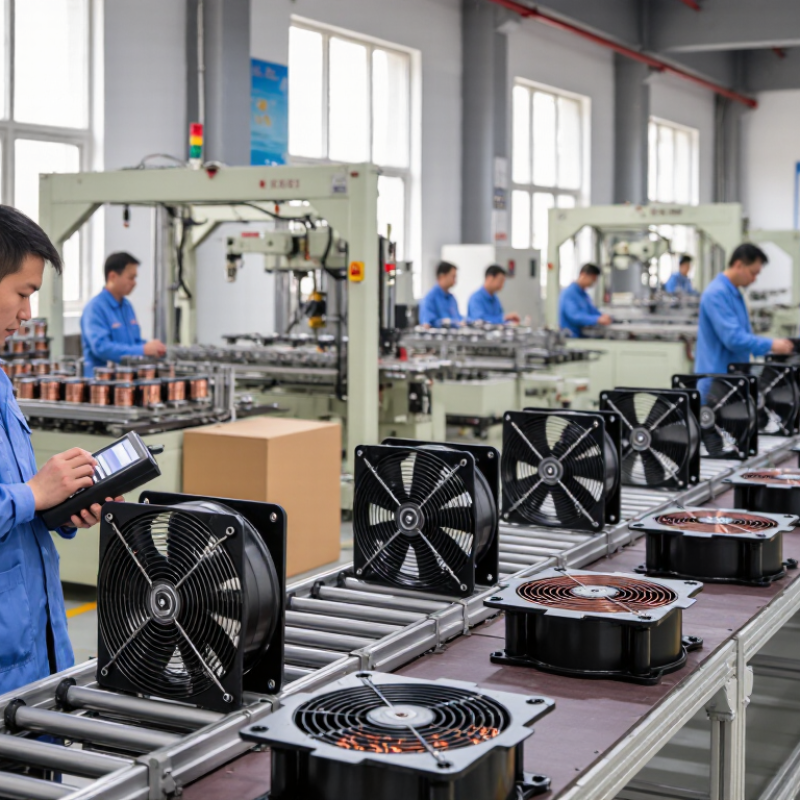
A reliable factory usually maintains mold accuracy, automatic winding equipment, rotor balancing, and controlled assembly lines. Each production batch should receive checks for current, speed, vibration, noise, and airflow. Thermal cycling and bearing tests can reveal weaknesses before shipment. Sample approval matters. The first sample may perform well, but mass production can expose small differences.
Procurement teams should request test records, material details, inspection standards, and traceable batch information. Compliance documents also require verification, not blind acceptance. In practical evaluations, communication speed often predicts project reliability. Still, no manufacturer is perfect. A supplier may offer excellent engineering but limited customization, or flexible design but weaker documentation. That trade-off needs honest discussion. The best choice depends on measured performance, application conditions, production consistency, and after-sales technical support.
Choosing the best DC axial fan manufacturer in China requires more than a low quotation. Quality begins with measurable airflow, pressure, noise, and electrical efficiency. AMCA 210 and ISO 5801 define recognized methods for testing fan performance. A reliable factory should provide test conditions, instrument accuracy, and repeatability data. Ask for the actual curve, not a decorative catalog number.
Energy matters too. The U.S. Department of Energy’s motor-system sourcebook estimates that motor-driven equipment consumes about 62% of industrial electricity. A small efficiency error can become expensive in continuous operation. IEC 60034-2-1 supports motor-loss testing, while temperature-rise checks reveal whether a 24-volt motor survives hot control cabinets. Review stall protection, bearing life, speed stability, and electromagnetic compatibility. Numbers must match the installed environment.
The details are physical. Listen for bearing roughness after several hours. Check whether the rotor starts at low voltage. Inspect solder joints, cable strain relief, and dust buildup around the guard. A practical sample test might compare rated airflow with airflow at 30 millimeters of water pressure. Results often fall below marketing claims. That is not automatically a failure; test fixtures and filters change the outcome. However, unexplained differences deserve investigation. Factory traceability, calibrated instruments, aging tests, and independent verification make supplier claims more credible. No test is perfect. Temperature and mounting still matter.
Selecting the best DC axial fan manufacturer in China requires more than comparing airflow and price. Application fit matters.
DC axial fans serve telecom cabinets, medical equipment, battery storage, LED lighting, HVAC units, and industrial control panels. The IEA’s The Future of Cooling report projects global space-cooling energy demand could more than triple by 2050. This pressure makes efficient thermal management increasingly important. A reliable fan supplier should provide measured airflow, static pressure, noise, power consumption, and operating-temperature data.
Customization begins with the enclosure. Engineers can specify 40 mm to 172 mm frame sizes, 12 V, 24 V, or 48 V input, PWM control, tachometer feedback, and locked-rotor protection. IP-rated designs suit dusty or humid locations. Ball bearings generally support longer service, while sleeve bearings can reduce cost in cleaner environments. Small details matter.
Testing must reflect real conditions. A fan rated at free-air performance may move far less air behind a grille or filter. AMCA publications emphasize standardized fan-performance testing, but field installation still changes results. I have seen designs fail because engineers trusted catalogue airflow alone. That mistake is common, and preventable. Custom samples, acoustic testing, vibration checks, and life testing should precede volume production. According to MarketsandMarkets, the global thermal-management market was projected to grow from about 16.3 billion dollars in 2023 to 24.7 billion dollars by 2028, increasing demand for dependable, configurable cooling components.
It should provide airflow, static pressure, voltage, noise, and service-life data. Ask for test conditions and batch records. Vague specifications need caution.
Common applications include server cabinets, medical equipment, battery storage, lighting, and industrial controls. Each enclosure creates different cooling resistance.
Common options include 12V, 24V, and 48V inputs. PWM control, tachometer feedback, and locked-rotor protection are also available.
Request airflow and pressure curves from controlled tests. Compare free-air airflow with airflow through a grille or filter. Test it installed.
Not always. Filters, guards, and narrow openings can reduce airflow significantly. A catalog value alone cannot predict field performance.
Inspect solder joints, cable strain relief, bearings, rotor balance, and protective guards. Listen for roughness after several operating hours. Small defects matter.
Ball bearings usually support longer service in demanding conditions. Sleeve bearings may cost less in cleaner environments. The choice depends on temperature and dust.
A sample can perform well while mass production varies. Check speed, current, vibration, noise, and airflow across several units. One sample is insufficient.
Fans running continuously can make small efficiency differences expensive. Check motor losses, temperature rise, and speed stability. Efficiency claims need measured evidence.
Compare measured performance, production consistency, customization, documentation, and technical support. One supplier may engineer well but document poorly. Trade-offs deserve honest discussion.
Choosing the best DC Axial Fan manufacturer in China requires more than comparing prices. A DC Axial Fan uses direct current to drive its motor and move air efficiently along the fan’s axis, making it suitable for electronics cooling, ventilation, and compact equipment. When evaluating manufacturers, buyers should consider production experience, motor and bearing quality, airflow and noise performance, energy efficiency, quality control systems, testing capabilities, delivery reliability, and after-sales support. A dependable supplier should also provide clear technical specifications and consistent product performance.
Leading manufacturers are typically recognized for their ability to offer stable quality, competitive production capacity, and flexible customization. Fan quality can be assessed through airflow, static pressure, operating noise, power consumption, temperature resistance, vibration control, lifespan, and protection ratings. Depending on the application, customization may include fan size, voltage, speed, connector type, control method, housing material, and specialized environmental protection. By carefully matching these factors with actual operating requirements, customers can select a safe, efficient, and durable DC Axial Fan solution.